
Real racing. Real stocks.
ACME is a skill-based racing game under the rules of top-level open-wheel racing. The fastest drivers win tokenized stocks of real companies, paid on Solana.
Not open to players yet. ACME's Solana programs are deployed on devnet, and mainnet follows an external audit.
Race free, win real stocks.
Every week, ACME's free time trial pays its top three a prize they can take in tokenized stocks: tokens on Solana, issued as xStocks, that track the shares of real companies. Each week features one stock, fixed when the week opens, and the top three share its prize: 50%, 30% and 20%.
Entry costs nothing. Every driver gets the same car and weather and the track to themselves: six laps a run, as many runs as they like, and the best clean lap of the week counts. Every run that sets a lap time is checked like a race between players, and the prize vault pays within limits written into the program.
 Tesla
 NVIDIA
 Apple
 S&P 500
 Microsoft
 Alphabet
 Amazon
 Meta
Straight to the winner's wallet
A winner takes the prize as the week's stock or in USDC, in one transaction they sign. The swap happens inside it, so the stock lands in their own wallet and ACME's programs never hold stocks.
Picked each week
The studio picks each week's stock from the short list, and the trial's screen names it from the moment the week opens. Once $ACME exists, its holders vote on it.
Unclaimed prizes
A prize its winner doesn't claim is sent to them in USDC once the claim window closes. Anyone can send it, and the server does.
A real racing game, won by driving.
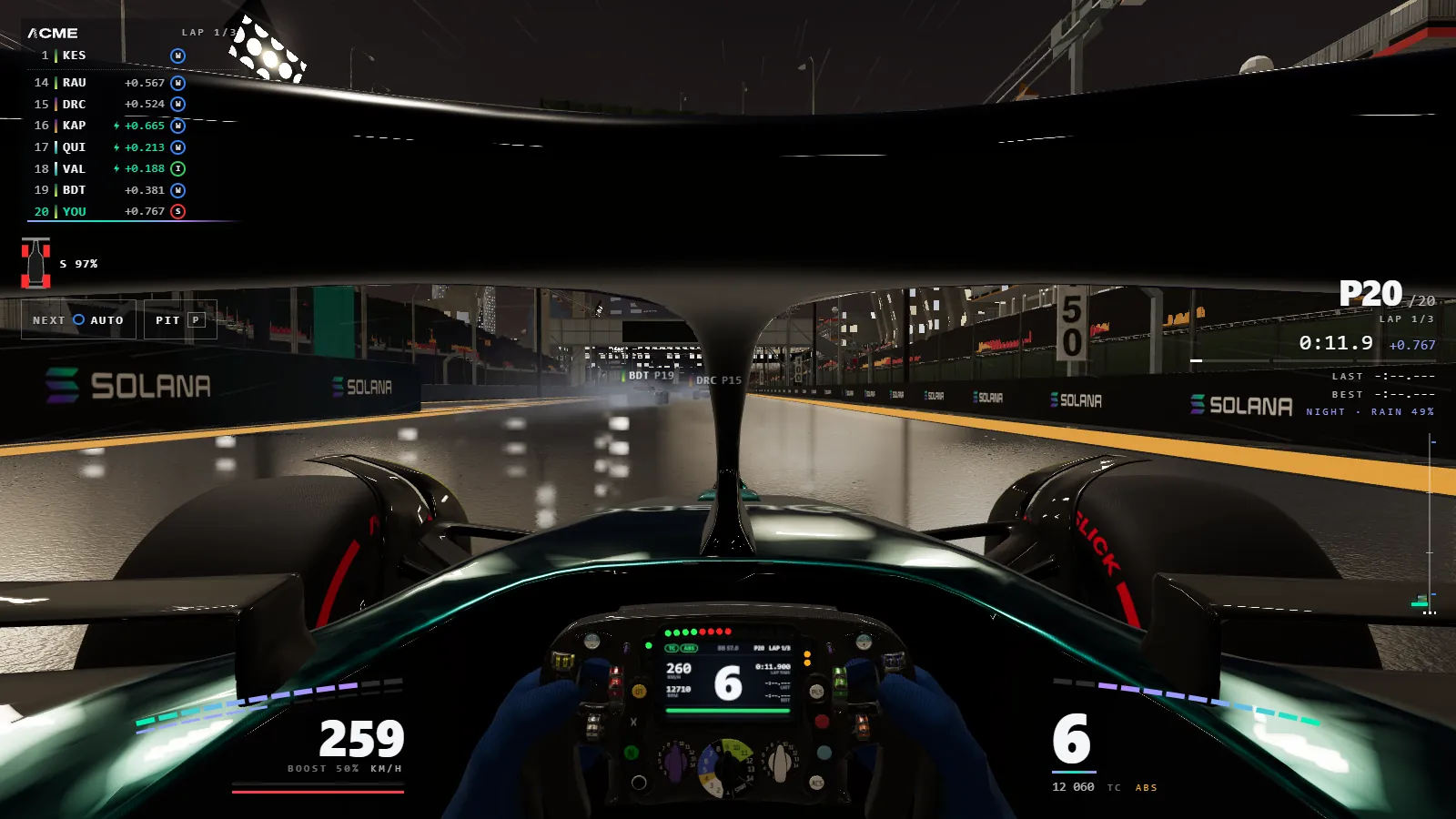
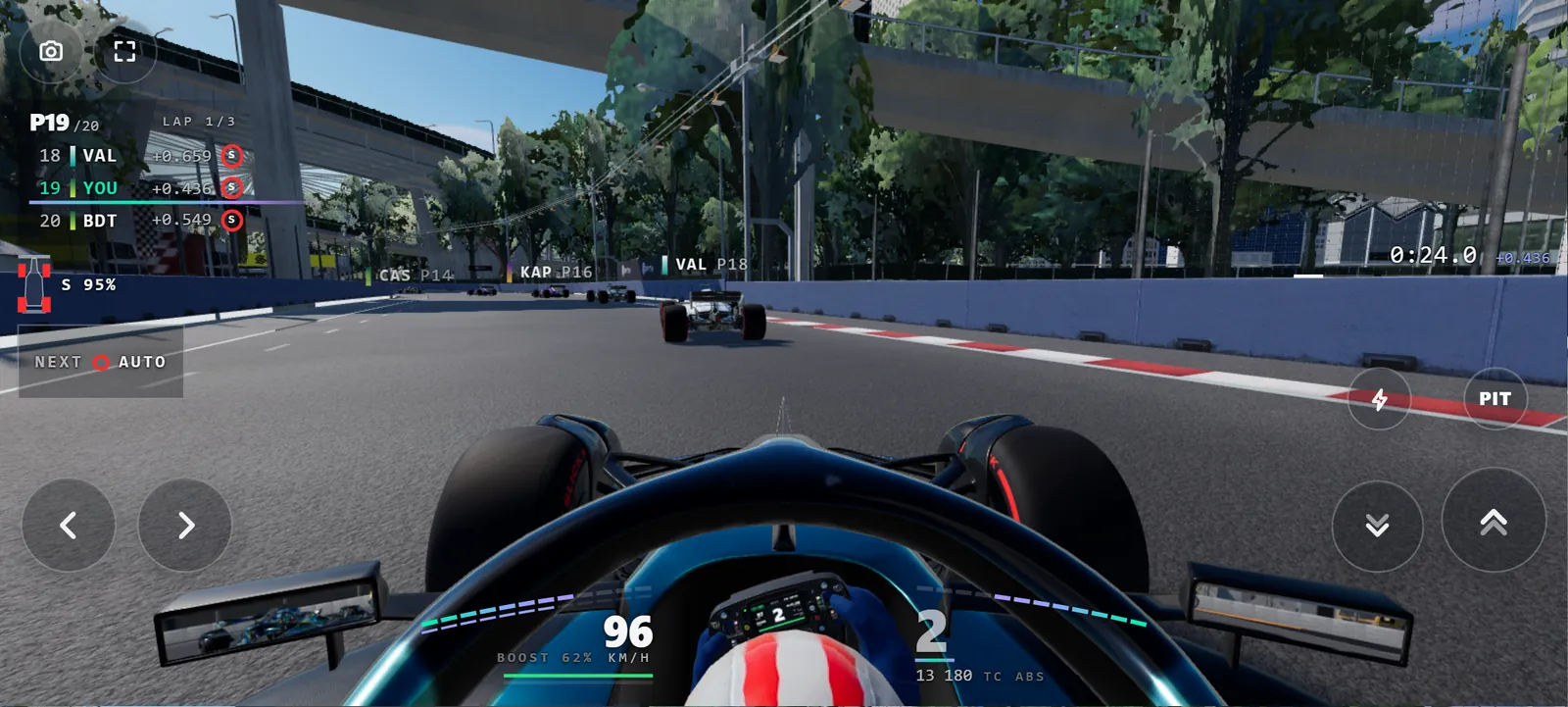
ACME is a racing simulation, not a game of chance. In an equal-cars room every driver races the same car, and the simulation is deterministic: the same inputs always produce the same race, to the last bit.
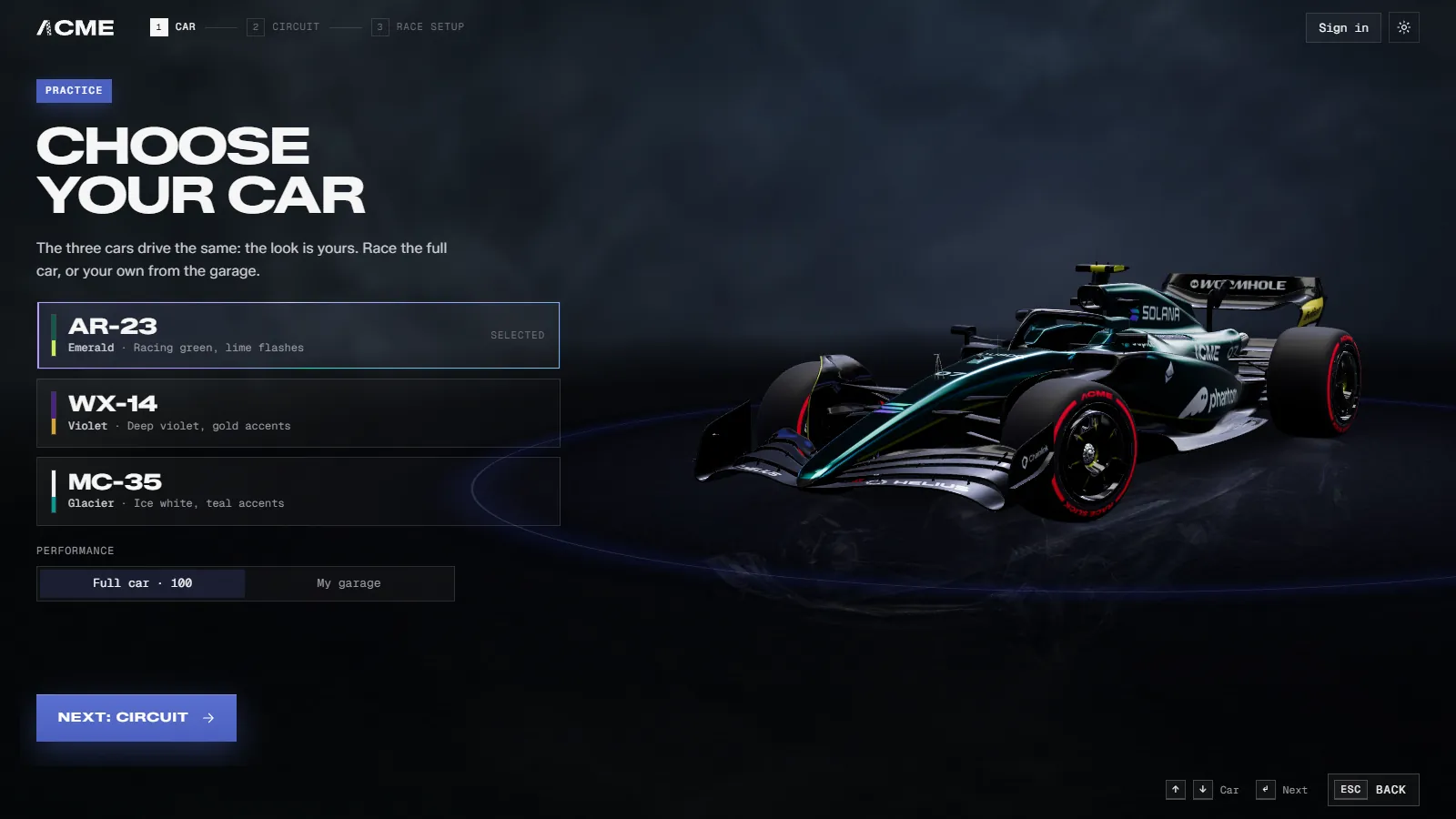
Players race each other in rooms of 2 to 8 drivers, open to all or behind an invite link, take on a daily challenge and a weekly time trial, and upgrade their car in the garage.
Tyres and strategy
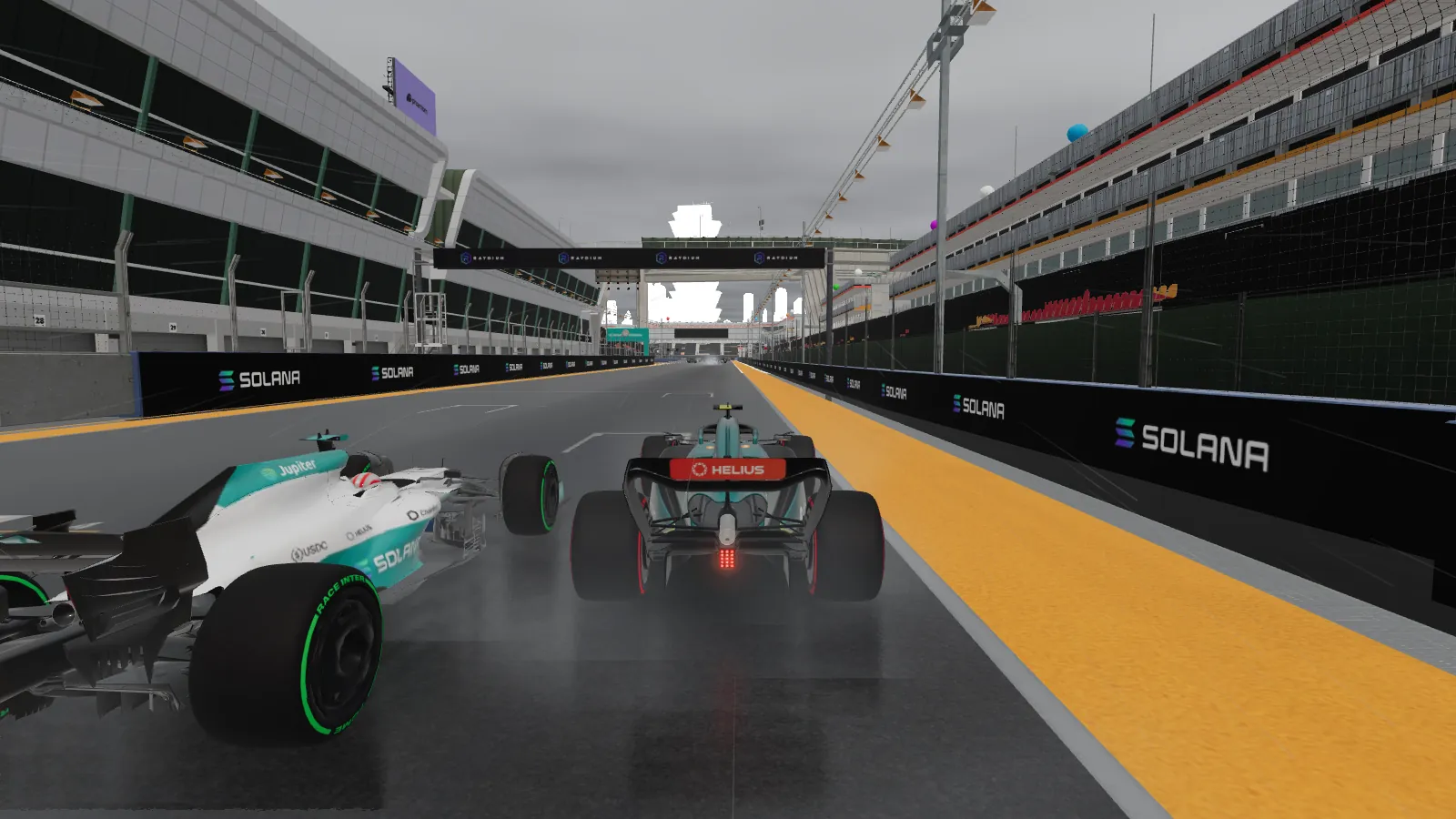
Soft, medium and hard compounds that wear lap by lap, and intermediates and wets for the rain. A Grand Prix makes every driver use two compounds, so every race has a strategy.
Pit stops
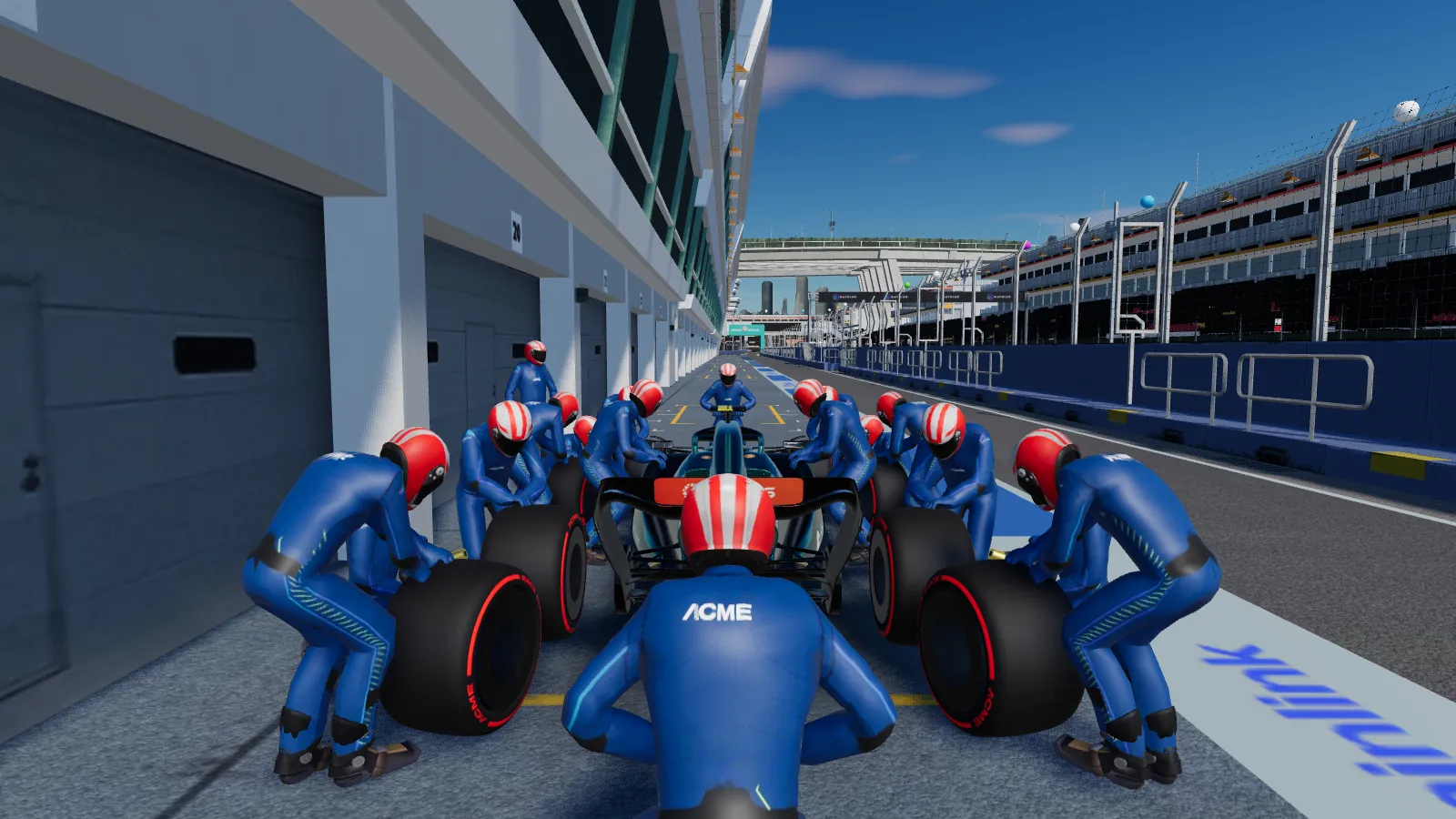
Drivers call their own stop and choose the tyres it fits. The pit lane has a 60 km/h limit, and a stop changes the tyres and repairs the front wing.
Damage
Contact damages the front wing and the chassis, and a damaged car is slower until it is repaired. A car too badly damaged is shown the black-and-orange flag and called into the pits.
Race control
Track limits, speeding in the pit lane and crossing the pit-exit line are judged in every race, and the penalties count in the results. Nothing is reset in a race.
The start and the finish
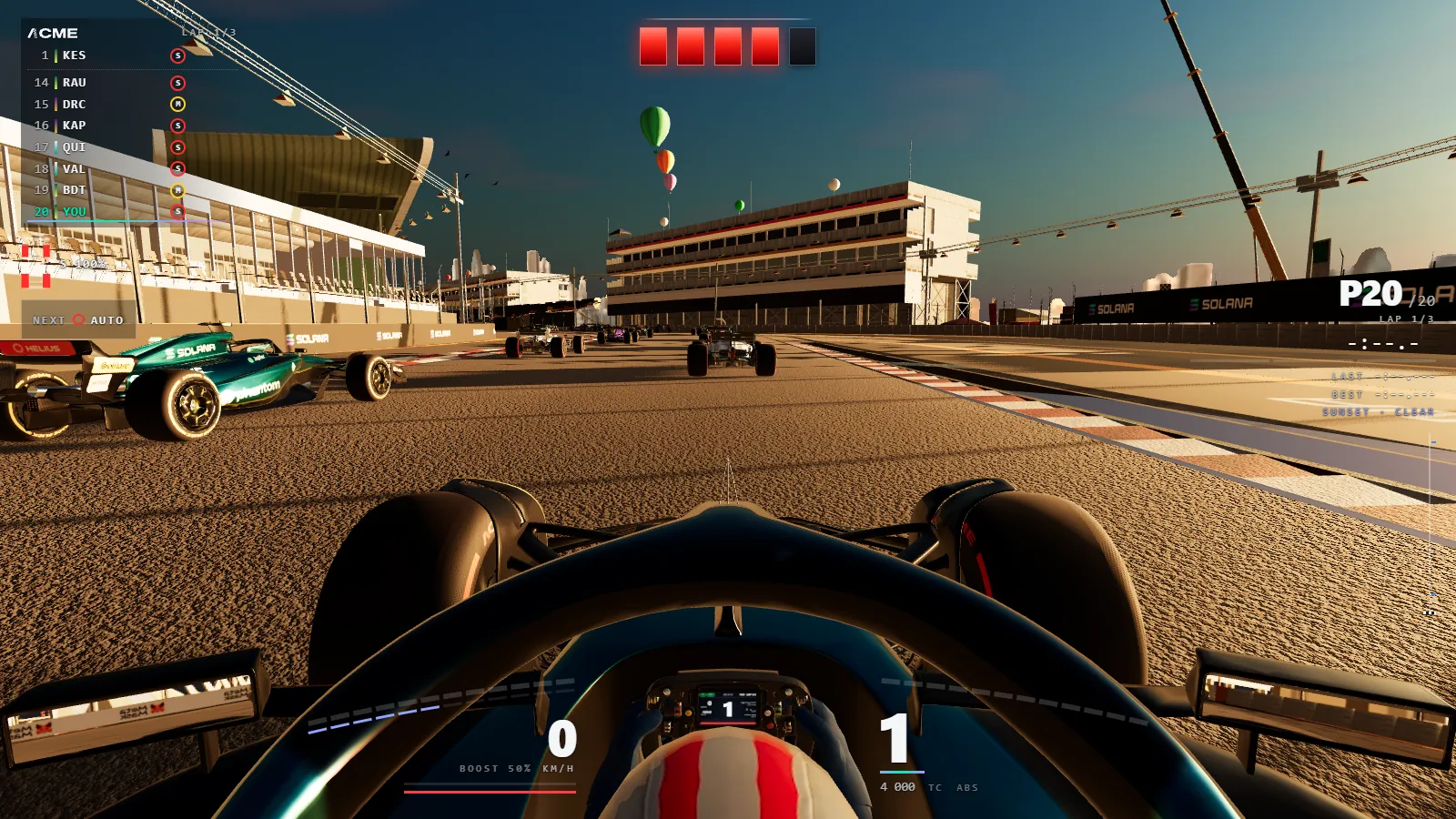
Five red lights, a standing start and the chequered flag after a set number of laps: 3 for a sprint and 5 for a Grand Prix, unless the room sets its own.
The rulebook, on-chain
The rules are frozen and hashed. Every room on Solana names the ruleset it is raced under, and every result records it, with the driving aids the driver chose to use.
How a race pays.
ACME's server runs each race: one referee for drivers who can't trust each other's devices. The programs on Solana limit what that referee can do with the money.
It can settle a race and pay its winner, or send every stake back. It can't pay anyone outside the race, change a stake or a fee after a room opens, or hold a player's money. If it stops, anyone can trigger every refund after a deadline.
Stakes go into escrow
Each player's stake moves into an account of the arena program, with one signature from their wallet.
The server runs the race
Every car is simulated 240 times a second, and every player's input is recorded.
The race is run again
Before anyone is paid, the server runs the race again from its record and compares the result.
The program pays
The times and the hash of the record go on-chain, and the winner is paid in the same transaction. With no result, every stake goes back with no fee.
Built on Solana.
Two Anchor programs hold the game's money, at the devnet addresses below: arena holds the players' (rooms, escrow, payouts and prize cups), and house holds the studio's (the treasury, its split and the garage).
Solana lets a race pay out in one transaction, confirmed in seconds, with the network fees paid by the game. Players sign in with their Solana wallet and race in USDC or SOL, a player racing in USDC needs no SOL at all, and every stake, payout, prize and upgrade is a transaction on Solana.
A seed from the chain
Each race's seed, which times the start lights and shapes changing weather, comes from a Solana slot hash after the grid is locked, so nobody knows it when they join.
The garage, on-chain
Upgrade levels are bought on-chain and belong to the player's wallet. A race with upgraded cars reads each car's levels from the chain, so nobody races with levels they don't own.
Two ways to sign
Players sign with their own wallet, or with a game wallet made from it the way trading terminals do. Held by Turnkey in secure hardware, it signs ACME's game transactions without a pop-up, and only the player's own wallet can take money out of it.
Checked before signing
The server builds each transaction. Before the wallet sees it, the page checks that it calls only ACME's programs, with the amounts the player chose.
Prize cups
Prizes sit in cups on-chain. Results go up as a Merkle root and stay open to challenge for 24 hours before anything is paid.
Reviewed and tested
The programs and the race server have had an internal security review. Every money path is tested on the programs alone and end to end, with the server, on a Solana validator.
On phones, headed for Google Play and the Solana dApp Store.
ACME plays on phones as well as desktops: touch controls, graphics tuned to each device, and menus sized for a thumb, upright or held sideways. A race runs in a phone's browser with nothing to install.
The plan is to publish ACME as an Android app on Google Play and in the Solana dApp Store, which comes on Solana Mobile's Seeker phone. Players sign with their own wallet app through Mobile Wallet Adapter. Google Play reaches most Android players, and the dApp Store the phones where Solana users keep their wallets.
The business model.
ACME earns from fees on races between players and on community cups, and from garage sales. Every fee and sale lands in one treasury on Solana, which splits it on-chain: 50% to the studio, 30% to the prize vault and 20% to buy and burn $ACME, or to prizes while the token doesn't exist.
Anyone can trigger the split, and changing it takes 7 days' public notice. If $ACME launches, the studio also receives the creator's share of its pool fees, in SOL. The game runs fully in SOL or USDC without the token.
| Source | What ACME takes |
|---|---|
| Races between players | 5% of the pot |
| Community cups | 10% of the entries; the cup's host gets a share of it, from the studio's half |
| The garage | Each upgrade level, paid in USDC, SOL or $ACME |
| Sponsored cups | A sponsor pays for a cup's prize |
| In USDC | A race: 4 × 5 | A cup: 40 × 5 |
|---|---|---|
| Paid in | 20.00 | 200.00 |
| Paid to the winners | 19.00 | 180.00 |
| The fee | 1.00 | 20.00 |
| To the studio | 0.50 | 10.00 |
| To the prize vault | 0.30 | 6.00 |
| To buy and burn $ACME | 0.20 | 4.00 |
What $ACME is for.
$ACME has not launched, and there is no date. It is designed with a fixed supply of 1,000,000,000 tokens, no mint or freeze authority, liquidity locked, and no tokens set aside for the studio or anyone else. Everyone, the studio included, buys after launch.
It is designed as a Token-2022 token with a transfer fee, and ACME's programs already handle that fee on every deposit and payout. The only official mint address will be posted on this page and by @AcmePlay.
A 1% tax, paid to holders in SOL
Every transfer of $ACME carries a 1% tax, paid to holders in SOL. The game's own transfers in $ACME, its stakes, payouts and garage payments, pay it too.
Holding it
A room opened by a holder takes a 2.5% fee instead of 5%, for everyone in it, and holders host community cups.
Spending it
Rooms staked in $ACME take a lower fee, and garage levels cost less when bought with it.
The burn
The treasury's burn share is sold in an open on-chain auction: buyers pay in $ACME, and that $ACME is burned.
What comes next.
Two new ways to race are being built now.
Seasons
A driver and a teammate race a calendar of up to 12 rounds. The top ten of each round score points for themselves and their team, 25 for a win, and the season's prize pool pays a drivers' table and a teams' table. Upgraded cars race here, so the garage counts.
Anti-gravity
A second way to race, in cars that hover above the track on thrusters, with stunts in the air. Its car is rigged and its first animations are made: a hover, and a kickflip flown on the car's own thrusters.
The order of work
- Every money path on devnet, with test USDC.
- Race challenges on X, as Solana Blinks.
- An external audit of both programs.
- Solana mainnet, with low stake limits.
Follow the build.
ACME posts its progress on X as it happens. Players, creators, partners and teams across Solana can reach the studio there or on Telegram.